

A practical guide to office carpet cleaning frequencies, methods and maintenance from an experienced London commercial cleaning company.
Office carpets rarely become dirty overnight.
It happens gradually.
Thousands of footsteps bring in grit, moisture and dirt. Tea gets spilled. Chairs move across the same areas. Busy routes between entrances, lifts and desks take more punishment than anywhere else.
Daily vacuuming deals with part of that.
But it doesn't deal with everything.
As a London-based commercial cleaning company, we maintain busy office environments where carpet care forms part of the wider cleaning programme. One thing we've learned is that there isn't one cleaning frequency that works for every carpet or every building.
The better question is this:
What condition is your carpet in, and what type of cleaning does it need next?
Daily Vacuuming Is Only the First Layer
Vacuuming matters.
In a well-run office cleaning programme, carpets should be vacuumed frequently enough to remove loose dirt before it gets worked further into the pile.
That includes:
- Dust
- Grit
- Crumbs
- Hair
- Loose debris
- Dirt brought in from outside
But vacuuming has its limits.
Over time, soil becomes embedded deeper into the carpet. Spills leave residues. Main walkways start looking darker and areas around entrances lose their original appearance.
You can vacuum a carpet every evening and still reach the point where it needs professional cleaning.
That's where planned carpet maintenance comes in.
So, How Often Should Office Carpets Be Professionally Cleaned?
There isn’t one fixed schedule for every office. The right frequency depends on footfall, building use, entrance matting, carpet condition and how quickly high-traffic areas begin to show wear.
Around 12 Months
Suitable for smaller offices with limited visitors, good entrance matting and relatively low daily traffic.
- Small professional offices
- Limited visitor traffic
- Quiet meeting spaces
- Good entrance matting
Every 6–12 Months
A practical range for many occupied commercial offices with regular staff movement, shared facilities and steady visitor traffic.
- Multi-team offices
- Shared kitchens and tea points
- Regular client meetings
- Moderate corridor traffic
Every 3–6 Months
Best suited to busy buildings where reception areas, corridors, lift lobbies and main walkways take significant daily use.
- Large corporate offices
- Busy reception areas
- Shared workspaces
- High visitor numbers
These are planning guidelines, not fixed rules. Carpet condition should always guide the final schedule. A quiet meeting room and a busy lift lobby rarely need the same treatment at the same time.
Low-Footfall Offices: Around Every 12 Months
A smaller office with limited visitors, effective entrance matting and relatively low footfall may only need a full professional clean annually.
Condition still matters.
If certain areas start deteriorating earlier, waiting for the annual clean doesn't make sense.
Medium-Footfall Offices: Every 6 to 12 Months
For a typical occupied commercial office, we'd expect carpet condition to be assessed throughout the year.
Professional cleaning every six to twelve months may be appropriate, depending on use.
Higher-traffic areas can be treated separately rather than cleaning the entire floor every time.
High-Footfall Offices: Every 3 to 6 Months in Key Areas
Busy offices require a different approach.
Reception areas, lift lobbies, corridors and main walkways can deteriorate much faster than meeting rooms or quieter parts of the building.
These areas may benefit from professional cleaning every three to six months.
That doesn't mean extracting every square metre of carpet four times a year.
A good programme targets the areas that actually need attention.
Your Whole Office Doesn't Need the Same Cleaning Frequency
This is where planned commercial carpet maintenance becomes important.
Walk through almost any busy office and you'll see predictable patterns.
The carpet directly inside the entrance gets more punishment than the corner of a meeting room. The route from the lifts to the main office gets more traffic than an occasional-use boardroom.
Areas we'd normally watch closely include:
- Entrances and reception areas
- Lift lobbies
- Main corridors
- Routes to washrooms
- Kitchen and tea-point entrances
- Breakout areas
- Printer and copier stations
- Meeting room entrances
- Main walkways between desks
These are often the first places where traffic lanes appear.
Once those lanes become noticeably darker, simply increasing the vacuuming isn't necessarily going to solve the problem.
What Makes Office Carpets Get Dirty Faster?
Two offices of the same size can need completely different carpet cleaning programmes.
There are several reasons for that.
What Makes Office Carpets Get Dirty Faster?
Two offices of the same size can need completely different carpet cleaning programmes. Footfall matters, but so do the building, the weather and what happens inside it every day.
Footfall
The more people moving through your building, the more soil, grit and moisture gets carried onto the carpet.
Entrance Matting
Good entrance matting captures dirt and moisture before it reaches the main carpeted areas of the building.
London Weather
A wet London morning can mean hundreds of damp shoes passing through reception before lunchtime, carrying street dirt deeper into the building.
Food & Drink
Coffee, tea, milk and food can leave behind more than a visible stain. Residue can remain within the carpet and attract further dirt.
Carpet Type
Colour, fibre and construction all affect how quickly soiling becomes visible and which cleaning method is most appropriate.
Cleaning frequency should follow the building, not just the calendar. Footfall, weather, matting and how different areas are used all help determine when professional carpet cleaning is actually needed.
Footfall
The more people moving through your building, the more dirt gets carried onto the carpet. And it isn't distributed evenly. A few heavily used routes can account for a large proportion of the visible wear.
Entrance Matting
Good entrance matting is one of the simplest ways to protect office flooring. It helps capture moisture and dirt before they're carried further into the building. If the matting is too small, poorly positioned or inadequately maintained, your carpets have to deal with the difference.
London Weather
This matters more than people sometimes realise. A wet morning in London means hundreds of damp shoes can pass through a busy reception before lunchtime. That moisture brings street dirt with it. Your carpet cleaning programme needs to account for seasonal changes rather than treating every month identically.
Food and Drink
Tea points and breakout areas tend to tell their own story. Coffee, tea, milk, food and sugary drinks can leave stains or residues that routine vacuuming cannot remove.
The Carpet Itself
Colour, fibre, construction and installation all affect how a carpet behaves. A dark carpet may hide soil better than a light one. That doesn't mean it isn't there.
Encapsulation or Extraction?
Not every carpet clean needs to use the same method.
Two methods commonly used in commercial environments are encapsulation cleaning and carpet extraction.
They do different jobs.
Encapsulation Cleaning
Encapsulation can be particularly useful as part of an interim maintenance programme.
A specialist cleaning solution is worked through the carpet. As it dries, it encapsulates loosened soil so it can subsequently be removed through vacuuming.
It can work well for:
- Traffic lanes
- Routine interim maintenance
- Large office areas
- Improving appearance between deeper cleans
- Sites where reducing downtime is important
One practical advantage is relatively quick drying. That can make a significant difference in an occupied commercial building.
Carpet Extraction
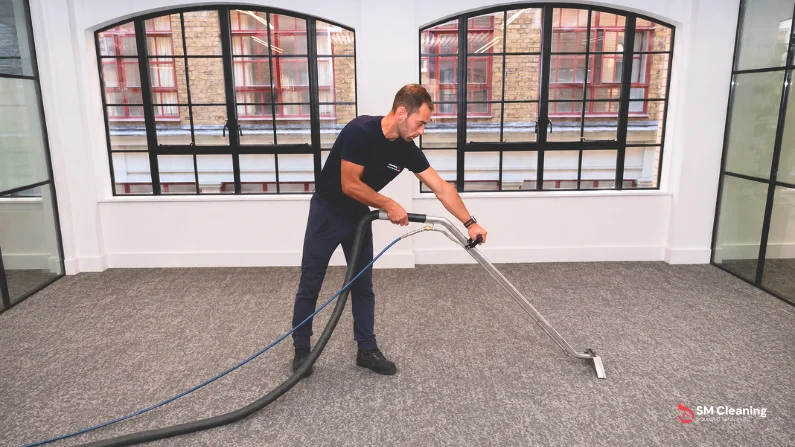
Extraction provides a deeper clean.
Water and the appropriate cleaning solution are worked into the carpet before being extracted along with loosened soil.
We'd consider extraction where carpets have:
- Heavier soiling
- Significant residue
- More substantial staining
- Build-up that interim cleaning isn't addressing
- Reached the point where a deeper restorative clean is required
Neither method is automatically "better".
The right choice depends on the carpet, its condition and how the building operates.
How Do You Know Your Office Carpet Is Due a Clean?
A calendar helps you plan maintenance.
Your eyes still matter.
Some of the clearest warning signs are:
- Dark traffic lanes appearing through corridors
- Entrance carpets looking noticeably duller
- Stains returning after spot treatment
- Carpet still looking tired immediately after vacuuming
- Persistent smells
- Matted or flattened areas
- Visible differences between exposed carpet and areas beneath furniture
- Darkening around doors and desk walkways
You shouldn't necessarily wait until several of these appear.
Once a carpet looks obviously dirty, the build-up has usually been developing for some time.
Why Leaving Carpet Cleaning Too Long Can Cost More
Commercial carpets are an asset.
Replacing them across a large office can mean significant cost and disruption, so it makes sense to maintain them properly.
One of the problems is grit.
Small abrasive particles become trapped within the carpet. As people continue walking over them, that contamination is repeatedly worked against the fibres.
Over time, appearance can deteriorate.
And there comes a point where you're no longer looking at dirt.
You're looking at wear.
That's an important distinction because cleaning can remove soil, but it can't reverse physical damage to a carpet fibre.
A sensible maintenance programme aims to intervene before the two become difficult to distinguish.
Sometimes the Carpet Doesn't Need Cleaning. It Needs Replacing.
This is worth saying.
Professional cleaning isn't magic.
If a carpet has reached the end of its usable life, repeatedly paying to clean it won't necessarily produce the result you're expecting.
We'd look carefully at issues such as:
- Permanent fibre damage
- Worn traffic lanes
- Damaged carpet tiles
- Delamination
- Significant fading
- Permanent staining
- Areas where the carpet no longer meets the presentation standard of the building
A good commercial cleaning contractor should be prepared to tell you when further restorative cleaning isn't the sensible option.
That's part of looking after your building properly.
Carpet Cleaning Should Be Part of the Contract
One of the easiest mistakes is treating carpet cleaning as something you arrange once the carpets look bad.
We prefer to think of it as a cycle.
Your cleaning specification might include:
- Routine vacuuming
- Immediate spot treatment
- Regular condition inspections
- Traffic-lane maintenance
- Planned encapsulation
- Periodic extraction
- Entrance mat maintenance
- Post-clean inspections
The exact schedule should reflect your building.
This is also why periodic cleaning needs to be clearly documented within your office cleaning contract. If it isn't, there's a risk everyone assumes somebody else is taking care of it.
How Much Does Commercial Carpet Cleaning Cost?
There isn't a meaningful single price per office.
The cost will depend on factors including:
- Carpeted floor area
- Current condition
- Cleaning method
- Furniture that needs moving
- Staining
- Access
- Working hours
- Drying requirements
- Frequency of maintenance
The condition when the contractor arrives matters too.
A carpet receiving planned maintenance is a different job from one requiring significant restorative work after years of accumulated soil.
That's why we'd look at the building before recommending the programme.
Clean Before the Carpet Looks Dirty
The best time to think about professional carpet cleaning isn't when somebody finally comments on the state of the floor.
By then, you've already noticed it.
Your visitors probably have too.
A better approach combines routine vacuuming with inspections, targeted interim cleaning and planned deeper cleaning where required.
It protects presentation without cleaning areas unnecessarily.
It also gives facilities teams a clearer picture of what is maintenance, what needs restoration and what may eventually need replacement.
At SM Cleaning & Support Services, we work across London commercial environments and manage cleaning as part of the wider condition of the building, not as a collection of isolated tasks. Our hands-on management approach means maintaining standards, spotting deterioration and taking action before smaller issues become bigger ones.
So rather than only asking:
"When was the carpet last cleaned?"
Ask:
"What condition is it in now, and what does it need next?"
That's a much better basis for a commercial carpet maintenance programme.
Frequently Asked Questions
How often should commercial office carpets be professionally cleaned?
As a general guide, lower-footfall offices may need professional cleaning annually, while busier environments may need attention every six months. High-traffic areas can require targeted cleaning every three to six months. Carpet condition should ultimately determine the schedule.
Is vacuuming enough to keep office carpets clean?
No. Vacuuming is essential for removing loose dust, grit and debris, but it cannot deal with every type of embedded soil, staining or residue. Periodic professional cleaning should sit alongside routine vacuuming.
How often should high-traffic carpet areas be cleaned?
Entrances, reception areas, corridors and lift lobbies may require professional cleaning every three to six months in busy buildings. They should be inspected regularly because footfall varies considerably between sites.
What is the difference between carpet extraction and encapsulation?
Encapsulation is particularly useful for interim maintenance and can offer faster drying. Extraction provides a deeper clean by using water and cleaning solution before extracting loosened soil. The appropriate method depends on carpet condition and operational requirements.
How long does commercial carpet take to dry after cleaning?
Drying time varies according to the method used, carpet construction, ventilation, temperature and conditions on-site. This should be considered when planning cleaning around office occupancy.
Can professional cleaning extend the life of office carpet?
A planned maintenance programme can help remove damaging soil and maintain the carpet's condition. However, cleaning cannot reverse fibres that have already suffered permanent physical wear.
How do I know whether a carpet needs cleaning or replacing?
If deterioration is caused mainly by soil, staining or residue, professional cleaning may significantly improve its appearance. Permanent fibre damage, worn areas, delamination or irreparable staining may indicate replacement is the better option.
How much does commercial carpet cleaning cost?
Costs depend on the area being cleaned, carpet condition, method, access, furniture, working hours and any specialist stain treatment required. A site assessment provides a much more useful basis for pricing than floor area alone.