

Sustainability gets talked about a lot in the cleaning industry.
Sometimes it’s genuine. Sometimes it’s just a label on a bottle.
Walk into most supply catalogues and everything looks “green”. Eco logos. Leaf symbols. Words like natural, sustainable or environmentally friendly printed across the packaging. It all sounds reassuring.
But in practice, the reality can be a bit murkier.
For businesses trying to make responsible choices about their workplace services, it’s worth understanding the difference between real environmental progress and simple marketing.
Why Sustainability Matters in Commercial Cleaning
Cleaning happens every day.
Often several times a day in busy buildings.
That means the products used, the equipment chosen and the way services are delivered all have an environmental footprint. Chemicals entering water systems, plastic packaging, energy use from equipment and transport between sites all add up.
Because cleaning is so routine, even small improvements in how it’s done can make a meaningful difference over time.
That’s why many organisations are now asking tougher questions about what “sustainable cleaning” actually means.
Where Greenwashing Shows Up
Greenwashing usually isn’t dramatic. It’s subtle.
A product might carry a leaf symbol or use words like eco-friendly without any meaningful explanation behind it. Sometimes the ingredients are only slightly different from conventional products. Other times the packaging has been redesigned to look sustainable even though the contents remain largely unchanged.
In commercial cleaning, this often appears in three areas.
1. Vague product claims
Labels like “green” or “natural” can mean very little without recognised certification or transparent ingredient information.
2. Surface-level sustainability
Some suppliers focus on a single improvement, such as recycled packaging, while the overall product still relies heavily on harsh chemicals.
3. Marketing-led sustainability
Sustainability becomes a branding exercise rather than a genuine operational shift.
None of these approaches necessarily make cleaning services more environmentally responsible.
What Real Sustainable Cleaning Looks Like
Genuine sustainability tends to be quieter.
Less marketing. More practical decisions.
In commercial cleaning, real progress usually shows up through consistent operational choices.
Product selection
Choosing cleaning products that are biodegradable, responsibly sourced and proven to reduce environmental impact.
Controlled chemical use
Using the minimum effective amount of product rather than over-applying chemicals.
Equipment efficiency
Modern equipment, such as backpack vacuums or low-water cleaning systems, can significantly reduce energy and resource use.
Waste reduction
Bulk refill systems and concentrated products help cut down plastic packaging and transport emissions.
Training and process
Sustainability only works when cleaning teams understand how and why products should be used properly.
Without that training, even the best products can be misused.
___
Across the London sites SM Cleaning supports, the focus stays the same… practical choices that genuinely reduce environmental impact, not just labels on a bottle.
Need a commercial cleaner for your organisation? Our team are ready to talk. Contact us today.
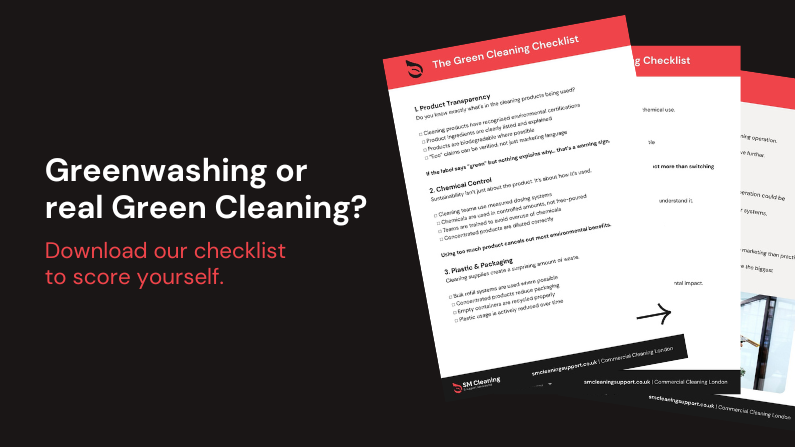
Why Operations Matter More Than Labels
Sustainable cleaning is less about individual products and more about how the entire service is run.
For example, a building could use eco-labelled products but still waste water, overuse chemicals or rely on inefficient equipment. In that situation, the environmental impact remains high despite the branding.
By contrast, a well-managed cleaning operation that uses measured product dosing, efficient machines and thoughtful scheduling can reduce environmental impact significantly.
The systems behind the cleaning matter as much as the products themselves.
Questions Businesses Should Be Asking
For organisations reviewing cleaning suppliers, a few practical questions can reveal whether sustainability claims are meaningful.
- What environmental certifications do your products carry?
- How do you control chemical usage on site?
- Do your teams receive training in sustainable cleaning practices?
- How do you reduce plastic waste from cleaning products?
- What equipment do you use to improve efficiency?
Clear answers to these questions usually indicate genuine commitment rather than marketing.
Sustainability Is a Long-Term Commitment
Sustainability in cleaning isn’t a one-off switch. It’s an ongoing process.
Products evolve, technology improves and expectations continue to change. The businesses making real progress tend to review their practices regularly and adjust as better solutions become available.
That approach may not always be the loudest, but it tends to be the most effective.
A More Honest Conversation About Cleaning
The cleaning industry plays an important role in maintaining healthy workplaces. It also has a responsibility to reduce its environmental impact where possible.
That starts with being honest about what works, what doesn’t and where improvements can be made.
Sustainability shouldn’t just be something printed on a label.
It should be something visible in how the work is actually done.
___
Summary: Sustainability in Commercial Cleaning: What’s Real vs Greenwash
Sustainability in commercial cleaning isn’t about labels or marketing claims. Real progress comes from how services are actually delivered… the products used, the way chemicals are controlled, and the systems behind the work. Businesses should look beyond “green” branding and focus on practical actions that genuinely reduce environmental impact. Ask clear questions, check the processes, and choose suppliers who can show how sustainability works in practice.
___
FAQs About Sustainability in Commercial Cleaning
1. What is greenwashing in commercial cleaning?
Greenwashing happens when cleaning products or services are marketed as environmentally friendly without meaningful evidence behind the claims. This can include vague labels like “eco” or “natural” that aren’t supported by certifications, ingredient transparency, or real operational changes.
2. How can businesses tell if a cleaning service is genuinely sustainable?
Look at how the service is run, not just the products being advertised. Ask about product certifications, chemical dosing systems, staff training, waste reduction, and equipment efficiency. Real sustainability usually shows up in everyday practices, not just branding.
3. Are eco-labelled cleaning products always better for the environment?
Not necessarily. Some products carry eco-friendly labels but still rely on chemicals or inefficient usage methods. The overall cleaning process, including how products are applied and managed on site, often matters more than the label itself.
4. Why does sustainability matter in commercial cleaning?
Cleaning happens every day in most workplaces. Because of this frequency, the chemicals, water, packaging, and energy involved can create a significant environmental footprint over time. Small improvements in how cleaning is delivered can make a meaningful difference.